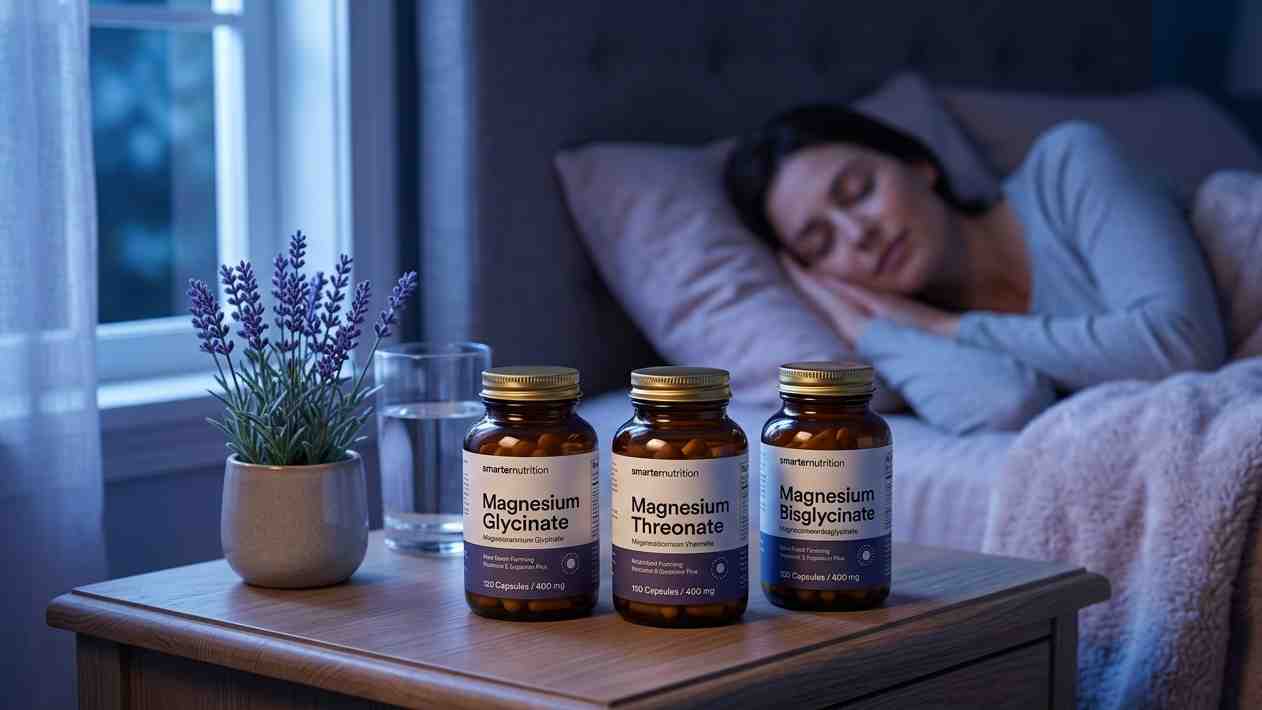
Magnesium for Sleep: Which Form Works Best — Glycinate, Threonate or Bisglycinate?
Magnesium is one of the most-searched supplements for sleep — and unlike many trending natural remedies, the search interest is matched by genuine clinical evidence. Three separate 2024 randomised controlled trials confirmed magnesium supplementation improves objective and subjective sleep outcomes. But the results vary significantly by form — and choosing the wrong form means spending money on a supplement that either doesn't reach the brain efficiently, or causes digestive issues that disrupt sleep further. This guide explains what the trials show and how to match the right form to your specific sleep problem.
Why Magnesium Affects Sleep: The Mechanisms
Magnesium influences sleep through three parallel neurological pathways — which is why its effects are more multi-dimensional than melatonin or herbal sleep aids that act through a single mechanism:
1. GABA Receptor Potentiation
GABA (gamma-aminobutyric acid) is the brain's primary inhibitory neurotransmitter — it reduces neuronal excitability and is essential for sleep onset. Magnesium directly potentiates GABA-A receptor activity — enhancing the calming, sleep-promoting effect of GABA already present in the brain. This is the same receptor targeted by prescription sleep medications (benzodiazepines) and the reason magnesium is especially useful for people whose insomnia is driven by racing thoughts or an overactive nervous system at night.
2. NMDA Receptor Blockade
Magnesium ions physically block NMDA (N-methyl-D-aspartate) glutamate receptors — which are responsible for nervous system excitation. At night, with reduced sensory input, these receptors should down-regulate to allow sleep. Magnesium deficiency reduces this blockade, keeping the brain in an inappropriately alert, excitable state. Mayo Clinic sleep medicine specialist Dr. Millstine explains it directly: magnesium helps maintain the right balance between excitatory and relaxing neurotransmitters — "if anxiety or racing thoughts keep you from getting to sleep, magnesium may shift the balance toward the relaxing neurotransmitters."
3. Melatonin Synthesis
Magnesium is a required cofactor in the enzymatic conversion of serotonin to melatonin in the pineal gland. Low magnesium status directly reduces melatonin output — delaying sleep onset and reducing sleep depth. This explains why magnesium supplementation often improves sleep in people who do not respond well to melatonin supplementation alone: the bottleneck is the magnesium-dependent conversion step, not melatonin availability.
The 2024 Clinical Trial Evidence
Magnesium L-Threonate: Objective Sleep Improvement
A 2024 double-blind, placebo-controlled RCT (Hausenblas et al., Sleep Medicine: X) enrolled 80 adults aged 35–55 with self-reported sleep problems, randomised to 1g/day magnesium L-threonate (MgT) or placebo for 21 days, with sleep measured both subjectively (Insomnia Severity Index, Leeds Sleep Evaluation Questionnaire) and objectively via Oura Ring wearable. Results:
- Significant improvement in subjective sleep quality scores versus placebo
- Objective improvement in sleep duration and deep sleep percentage
- Improved daytime functioning — energy, productivity, and readiness scores
- Positive effects on mood and reduced anxiety (Profile of Mood States)
- No adverse events; well tolerated at 1g/day
The key advantage of MgT is its brain bioavailability. Magnesium L-threonate was specifically developed at MIT to cross the blood-brain barrier efficiently — delivering higher brain magnesium concentrations than any other supplemental form. This makes it the most physiologically targeted form for sleep and neurological applications.
Magnesium Bisglycinate: Insomnia Symptom Reduction
A 2025-published RCT (Schuster et al., Nature and Science of Sleep) enrolled 155 adults aged 18–65 with self-reported poor sleep quality to receive magnesium bisglycinate or placebo for 28 days. The Regensburg Insomnia Scale confirmed significant insomnia symptom reduction in the magnesium group versus placebo. Bisglycinate (the chelated form of glycinate) has excellent gastrointestinal tolerability — important for sleep supplementation since digestive discomfort is counterproductive to sleep onset.
Magnesium Crossover RCT: Sleep Duration, Deep Sleep and HRV
A 2024 double-blind crossover RCT (Breus et al., Medical Research Archives) in 31 adults randomised to 1g/day magnesium or placebo for 2 weeks (then crossed over) found significant improvements in the magnesium condition for: sleep duration, deep sleep percentage, sleep efficiency, readiness score, activity balance, and heart rate variability readiness — with HRV improvement being a particularly notable finding, as it reflects parasympathetic nervous system recovery and overall physiological resilience.
Which Form for Which Sleep Problem?
Racing thoughts / anxiety-driven insomnia → Magnesium Glycinate or L-Threonate
The GABA potentiation and NMDA blockade mechanisms are most relevant here. Glycinate is the most bioavailable standard form with the added benefit of glycine (independently calming). L-Threonate is preferred when brain delivery is the priority — particularly for chronic, treatment-resistant anxiety-insomnia.
Difficulty achieving deep sleep / waking unrefreshed → Magnesium L-Threonate
The Hausenblas trial specifically showed objective improvement in deep sleep percentage — the restorative stage associated with growth hormone release, immune repair, and memory consolidation. L-Threonate's brain bioavailability makes it most effective for this specific outcome.
Insomnia with muscle tension / restless legs → Magnesium Glycinate or Malate
Magnesium's role as the physiological calcium antagonist — responsible for muscle relaxation — is most relevant here. Glycinate provides good absorption without the laxative effect of citrate. A 2019 systematic review (Marshall et al., Sleep Medicine Reviews) found magnesium supplementation beneficial for restless legs syndrome and periodic limb movement disorder.
Poor sleep alongside low energy and fatigue → Magnesium Malate
Malate (malic acid) is a Krebs cycle intermediate involved in ATP energy production — making this form useful when daytime fatigue accompanies sleep disruption.
Dosage and Timing for Sleep
- Timing: Take 1–2 hours before bedtime — allows absorption and brain concentration to peak during sleep initiation
- Dose: 200–400mg elemental magnesium. Check label: "magnesium glycinate 400mg" typically contains ~50mg elemental magnesium — verify the elemental content
- Duration: Most trials show meaningful effects within 3–4 weeks. Some people notice lighter improvement within the first week
- Avoid magnesium oxide for sleep — less than 5% bioavailability means almost none reaches systemic circulation; effective only as a laxative
- Combine with: Consistent sleep/wake schedule and a dark sleep environment — magnesium's melatonin-supporting mechanism is most effective when circadian signals are consistent
References
- Hausenblas HA, et al. (2024). Magnesium L-threonate for sleep quality: RCT. Sleep Medicine: X, 8:100121.
- Schuster J, et al. (2025). Magnesium bisglycinate for insomnia: RCT 155 adults. Nat Sci Sleep, 17:2027–2040.
- Breus MJ, et al. (2024). Magnesium for sleep quality and mood: crossover RCT. Medical Research Archives, 12(7).
- Mayo Clinic Press. (2024). Magnesium for sleep: Dr. Millstine commentary.
- Marshall NS, et al. (2019). Magnesium for restless legs: systematic review. Sleep Medicine Reviews, 48:101218.