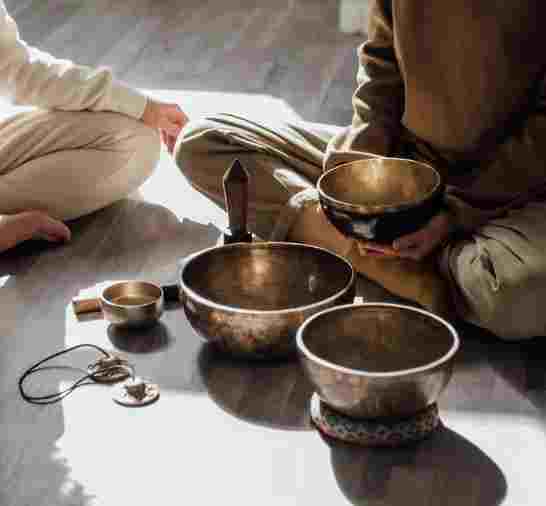
What Are Singing Bowls?
Singing bowls are metal or crystal bowls that produce sustained, resonant tones when struck or rimmed with a mallet. Originating in Himalayan Buddhist and Hindu traditions (Tibet, Nepal, India), they are used as meditation aids, sound therapy instruments, and ritual objects. The sustained vibrations — both audible and tactile — create a distinctive immersive quality that many practitioners find easier to focus on than the breath, making them useful as an alternative anchor for meditation practice.
The Clinical Evidence for Sound Meditation
Sound bath therapy and singing bowl meditation are among the more recently studied natural wellness interventions, with a small but growing body of clinical evidence:
- A 2016 study published in the Journal of Evidence-Based Complementary and Alternative Medicine (Goldsby et al.) found that singing bowl meditation significantly reduced tension, anxiety, fatigue, and depressed mood in 62 participants — with greater benefits in those new to the practice
- Participants reported significant increases in spiritual wellbeing and significant decreases in pain
- Heart rate and blood pressure measurements confirmed a measurable physiological relaxation response — not just subjective reports
- A 2020 study found Himalayan singing bowl sessions reduced systolic blood pressure and heart rate in pre-hypertensive adults
The proposed mechanism involves the acoustic vibrations stimulating the parasympathetic nervous system — the "rest and digest" counterpart to the anxiety-driving sympathetic system. The tactile vibration component (felt as well as heard when the bowl is held) may contribute additional somatosensory relaxation effects.
Types of Singing Bowls
Tibetan / Himalayan Metal Bowls
Traditionally hand-hammered from an alloy of multiple metals (historically 7 metals corresponding to celestial bodies — gold, silver, mercury, copper, iron, tin, lead). Modern production bowls are typically 3–5 metal alloys. Hand-hammered bowls produce richer, more complex harmonic overtones than machine-made bowls. Size determines pitch — larger bowls produce deeper, lower frequencies; smaller bowls produce higher, brighter tones. Played by striking with a padded mallet or rimming clockwise with a wooden mallet.
Crystal Singing Bowls
Made from crushed quartz crystal heated to high temperature — produce a pure, sustained sine-wave tone quite different from the complex harmonics of metal bowls. Crystal bowls are louder and project further — better for group sound bath settings. The pure tone is easier for some people to focus on for extended periods. Fragile and heavier than metal bowls.
Tuning Forks
Precise frequency instruments used in sound healing for targeted application. Commonly used frequencies include 432 Hz (claimed to be more harmonically aligned with natural resonance), 528 Hz (the "love frequency" in sound healing traditions), and the Solfeggio frequencies. Clinical evidence for specific frequencies is minimal — the relaxation response appears to be the general acoustic mechanism rather than any specific Hz value.
How to Use for Meditation
- As a session opener: Strike the bowl and focus attention on the sustained tone until it fades completely — this is a simple, effective mindfulness exercise that trains sustained attention
- As a breath anchor replacement: For those who find breath-focused meditation frustrating, the bowl tone provides an easier initial attention anchor
- Sound bath practice: Play multiple bowls in sequence or simultaneously, allowing the overlapping tones to fill awareness — a more passive, receptive form of meditation that many find deeply relaxing
- Choosing a bowl: For personal practice, a 10–20cm metal bowl in the mid-range price bracket (£30–£80) is sufficient to start. Avoid very cheap machine-made bowls — the tone quality affects the practice experience significantly