Supplement
Creatine
One of the most researched supplements in science — with emerging longevity evidence for muscle preservation after 40, cognitive function and mitochondrial energy production.
One of the most researched supplements in science — with emerging longevity evidence for muscle preservation after 40, cognitive function and mitochondrial energy production.
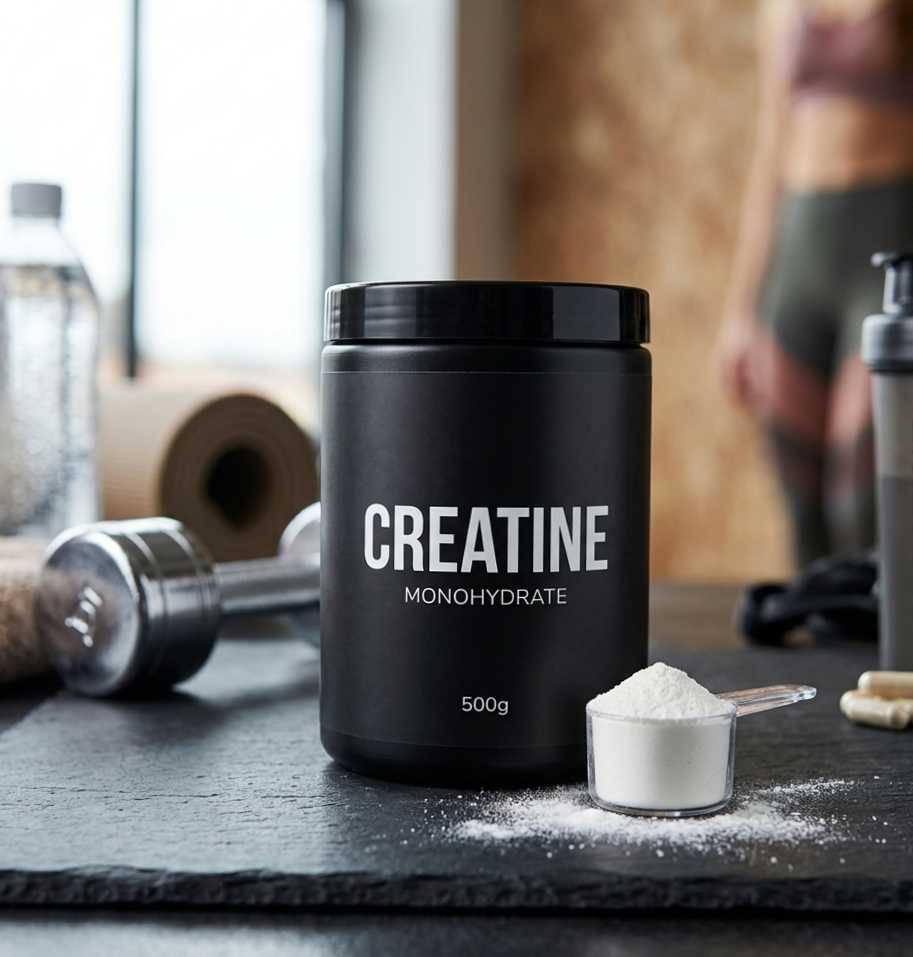
Creatine is a naturally occurring compound synthesised in the liver, kidneys, and pancreas from the amino acids arginine, glycine, and methionine. Approximately 95% of the body's creatine is stored in skeletal muscle as phosphocreatine — a rapid-access energy reserve that replenishes ATP during high-intensity efforts. The remaining 5% is stored in the brain, heart, and other tissues.
Creatine monohydrate is the most extensively researched sports supplement in history with over 500 peer-reviewed studies. Increasingly, it is recognised as a compelling compound for healthy ageing — preserving the muscle mass, cognitive function, and bone density that decline with age.
Adults lose 3-8% of skeletal muscle mass per decade after age 30, accelerating to 5-10% after age 60. Sarcopenia drives disability, falls, metabolic disease, and reduced quality of life. Skeletal muscle is also the primary site of glucose disposal, the largest amino acid reservoir, and a major metabolic rate determinant. Creatine consistently increases muscle mass and strength — particularly combined with resistance training — making it one of the most evidence-based interventions for sarcopenia prevention.
The brain accounts for 20% of total energy expenditure, and neuronal firing depends on ATP. The phosphocreatine system buffers against intensive cognitive demand. A 2022 meta-analysis (Avgerinos et al., Nutritional Neuroscience) of 6 RCTs found creatine significantly improved short-term memory and reasoning in healthy adults — most pronounced in vegetarians and older adults. A 2024 RCT found creatine improved cognitive function and reduced mental fatigue in sleep-deprived individuals.
Multiple RCTs show creatine combined with resistance training produces significantly greater bone mineral density improvements than training alone — particularly at the hip and spine in postmenopausal women — through enhanced anabolic signalling in bone-forming osteoblasts.
The creatine kinase reaction that regenerates ATP is located in the mitochondrial inner membrane — making creatine integral to mitochondrial energy transfer, not just a muscle store. Research shows creatine reduces mitochondrial oxidative stress and improves mitochondrial respiration efficiency. Complementary to CoQ10 for mitochondrial support.
Creatine reduces plasma homocysteine — an independent cardiovascular risk factor elevated in 30-40% of adults over 50. Muscle mass preservation from creatine use directly improves insulin sensitivity and glucose metabolism — addressing a core driver of accelerated ageing.
Creatine monohydrate has one of the most thoroughly studied safety records in nutrition research. Claims that it damages kidneys are not supported by the evidence — multiple long-term studies confirm no adverse effects on renal function at standard doses in healthy individuals. The International Society of Sports Nutrition considers creatine monohydrate safe for long-term use.
Creatine monohydrate is the most evidence-backed and cost-effective form — no alternative form has shown superior clinical outcomes. Standard dose: 3-5g daily, taken consistently. Loading (20g/day for 5-7 days) saturates muscle creatine faster but is not necessary — standard dosing achieves full saturation in about 4 weeks. Dissolve in water or a carbohydrate drink — insulin enhances uptake. For cognitive and anti-aging use without training, 3-5g daily at any consistent time is appropriate.
In-depth science-based articles about this product

Creatine is the most researched supplement in sports science — but its anti-aging applications go...

A 2024 meta-analysis of 20 RCTs in 1,093 adults aged 55+ found creatine combined with exercise train...
A 2024 meta-analysis of 16 RCTs found creatine monohydrate significantly improved memory (SMD 0.31),...

Over 1,000 studies confirm creatine monohydrate is safe. But its reputation as a bodybuilding supple...
Learn more about how Creatine supports these health areas