How to Start Meditating: A Science-Based Beginner's Guide to Building a Daily Practice
Most people who try to start meditating quit within two weeks. Not because meditation doesn't work — the evidence that it does is extensive — but because the way it is typically taught creates unrealistic expectations, and the first experience of a restless, distracted mind feels like failure rather than the normal starting point it actually is.
This guide takes a different approach: building on what the neuroscience of habit formation and the clinical trial evidence on meditation both show about how to start effectively, maintain a practice, and understand what is actually happening in your brain during the process.
What Meditation Actually Is (and Is Not)
The single most common misconception about meditation is that the goal is to stop thinking or achieve a blank mind. This misunderstanding causes most beginners to evaluate themselves as failing every time a thought arises during practice — which is to say, constantly.
Meditation is not the absence of thought. It is the training of attention. The moment you notice your mind has wandered and return your attention to the breath, you have just performed one repetition of the core mental exercise. Every moment of noticing is a moment of success. A session with 50 distractions that you noticed and returned from is not a bad session — it is a session with 50 repetitions.
The neuroscientific evidence supports this framing precisely. The default mode network (DMN) — the brain's "mind-wandering" system — is active approximately 47% of waking time in most adults. Meditation does not suppress this network; it trains the prefrontal cortex to detect its activation and redirect it. Over weeks to months of practice, this detection becomes faster and more automatic. This is the cognitive mechanism behind meditation's benefits for anxiety and attention: not the prevention of anxious thoughts, but the progressive shortening of the time those thoughts go unnoticed and unchecked.
How Long Until You See Results? What the Neuroscience Shows
This is one of the most practically important questions for beginners, and the research provides clear and encouraging answers:
- Immediate (session 1): A single 15-minute mindfulness session reduces state anxiety and increases measures of calm in healthy adults — documented in RCTs with pre/post anxiety measurement. The acute stress-reducing effects of meditation begin with the very first practice.
- 1–2 weeks: Measurable improvements in perceived stress and sleep quality begin appearing in studies using daily practice even as short as 10 minutes. A 2021 study found that even brief daily mindfulness practice (10 minutes/day for 10 days) produced significant reductions in anxiety and depression compared to controls.
- 4 weeks: Significant improvements in attention control and emotional regulation. A 2010 study found 4 weeks of mindfulness training (30 minutes/day) significantly improved sustained attention and working memory capacity.
- 8 weeks: The MBSR standard that produces the structural brain changes now documented in the neuroimaging literature. After 8 weeks, grey matter density increases in the hippocampus (learning and memory), posterior cingulate cortex (mind-wandering), and temporoparietal junction (perspective-taking and empathy). Grey matter density in the amygdala (stress reactivity) decreases — the neural signature of reduced anxiety reactivity.
- Persistence threshold: Research on meditation practice persistence (a 2023 PMC study, n=953) found that almost half of adults who tried meditation (49.3%) had lifetime exposure, but only a third (35%) maintained practice in the past year — suggesting that 8 weeks of consistent practice, not just starting, is the threshold that creates durable habit.
The Beginner Practice: Start With 5 Minutes
The single most evidence-supported starting point is a simple breath focus practice. Here is the exact method:
Setup
- Sit comfortably — chair, floor, cushion, bed edge. Posture matters only in that it should allow alertness without strain. Lying down works if you can stay awake.
- Set a timer for 5 minutes. Not 20 minutes. Not 10 minutes. 5 minutes creates a manageable commitment that is easier to maintain than it is to skip — the foundation of habit formation.
- Close your eyes or soften your gaze downward at a 45-degree angle.
The Practice
Bring attention to the physical sensations of breathing. Not the idea of breathing — the actual physical sensations: the coolness of air at the nostrils, the slight expansion of the chest or belly, the warmth of the exhale.
When a thought arises — and it will, within seconds — simply notice it, label it lightly if you like ("thinking"), and return attention to the breath.
That is the entire practice.
There is no correct experience to have. If you feel calm, that is fine. If you feel restless, distracted, bored, anxious, or like nothing is happening — that is equally fine. The benefit comes from the returning, not from any particular state achieved.
Scaling Up
Add 1 minute per week. After 4 weeks you will be at 8–9 minutes per day — already within the range where significant benefits are documented in clinical trials. A sustainable 10–15 minute daily practice produces better outcomes than occasional 30-minute sessions.
The 5 Most Common Obstacles and Evidence-Based Solutions
1. "My mind won't stop racing."
This is not a sign you cannot meditate. It is the beginning of meditation awareness — you are noticing something that was always happening. The technique: label your thoughts by type rather than content. "Planning. Worrying. Remembering. Planning again." This metacognitive labelling activates the prefrontal cortex and creates a slight distance from thought content, reducing its emotional grip. Research on labelling affect (Lieberman et al., UCLA) shows it reduces amygdala activation within seconds.
2. "I fall asleep."
Usually means you are sleep-deprived (fix the sleep debt) or sitting in a reclined position. Practice at a time of day when you are more alert — after showering in the morning is often effective. Meditate with eyes partly open, gaze directed softly downward, if complete eye closure triggers sleep. If you genuinely need the sleep, sleep. Yoga Nidra (a specific body-scan rest protocol) is designed to sit at the sleep boundary and may be more appropriate than seated meditation when fatigue is severe.
3. "I don't have time."
The minimum effective dose for most documented benefits is 10 minutes/day. This is less time than most people spend scrolling a phone after waking up. The research on implementation intentions (Gollwitzer) shows that specifying exactly when and where you will practice (e.g. "after I put the kettle on in the morning, I will sit on the kitchen chair for 10 minutes") increases follow-through by up to 300% compared to general intentions like "I will meditate daily."
4. "I tried it and felt more anxious."
This happens. The adverse effects literature documents that a minority of meditators (particularly those with trauma history or untreated anxiety disorders) experience increased anxiety during initial practice. The evidence-based response: start shorter (3–5 minutes, not 20), keep eyes open, prefer movement-based mindfulness (mindful walking, mindful eating) over seated practice initially, and consider guided meditation via an app rather than unguided silence. If anxiety consistently increases, a clinical mindfulness teacher or therapist is more appropriate than self-directed practice.
5. "I don't know if I'm doing it right."
There is no single correct meditation experience. However, if you want objective feedback: the Muse EEG headband provides real-time brain activity feedback that tells you whether your brain is in a calm, active, or neutral state during practice. This removes the subjective uncertainty that undermines confidence in early practice. It is not necessary, but for analytical personalities who respond to metrics, it changes the experience of learning.
Building the Habit: The Science of Consistency
The neuroscience of habit formation (Duhigg, Wood, Neal) identifies three elements that create durable habits: cue, routine, reward.
- Cue: Attach meditation to an existing daily habit — making coffee, finishing exercise, sitting down at your desk. The existing behaviour triggers the new one without relying on motivation or decision-making.
- Routine: Keep it short enough to feel easy. A 5-minute practice done daily for 90 days creates more neural change than a 20-minute practice done irregularly.
- Reward: Track the practice (any app, any paper, a simple calendar tick) and observe how you feel for the 2 hours after each session. The intrinsic benefit — calmer, clearer, slightly more able to pause before reacting — is the reward. Noticing it consciously reinforces the behaviour.
The PMC persistence study found that people who reported social norms supporting meditation (knowing others who practice, having a teacher) were significantly more likely to maintain the habit. If solo practice is not sticking after 4 weeks, finding a local or online group — many MBSR centres run ongoing drop-in sessions — adds the social reinforcement that makes the difference.
Tools That Help
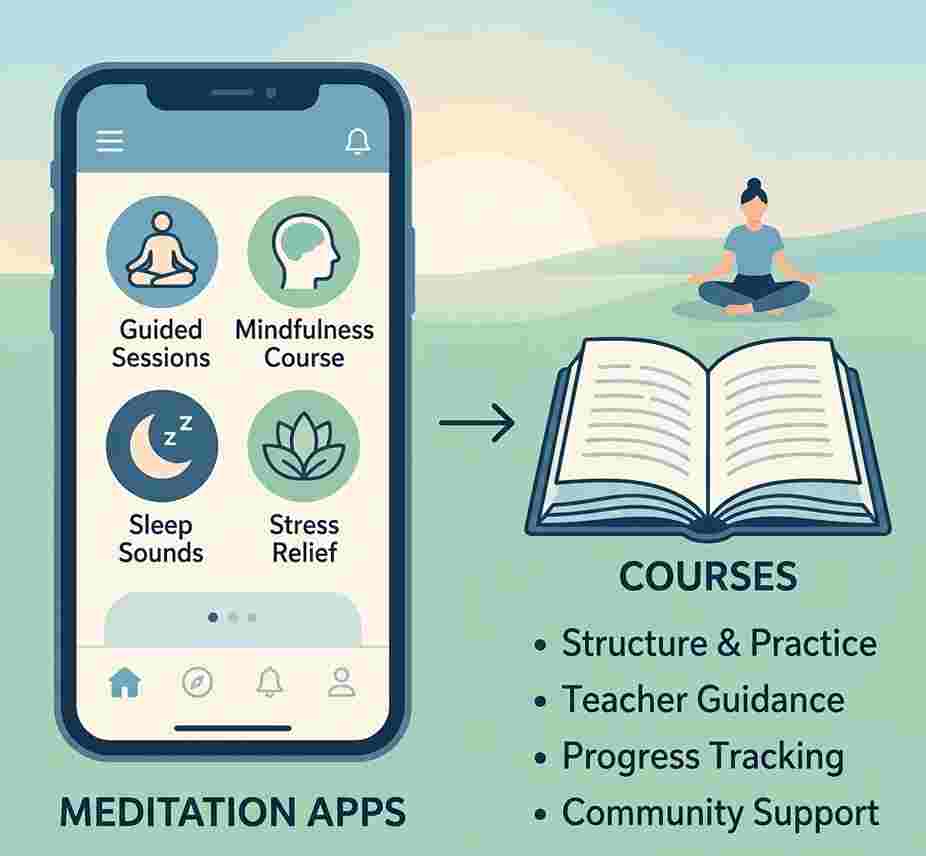
The evidence for guided meditation apps is positive: a meta-analysis of digital mindfulness-based interventions confirmed significant effects on anxiety, depression, and stress. The best apps for evidence-based practice include:
- Insight Timer — the largest free meditation library, including structured MBSR programmes, loving-kindness courses, and thousands of individual sessions. No paywall for the core content.
- Waking Up (Sam Harris) — specifically designed around the insight meditation tradition; includes a theory-dense "Daily Meditation" series and a no-cost option for those who cannot afford the subscription.
- Headspace — the most beginner-friendly UX; 30-session "Basics" course well-structured for the first month.
For posture support — the physical discomfort of sitting without back support is one of the most commonly cited barriers to sustained practice — a good meditation cushion (zafu) or a low meditation bench positions the pelvis correctly and removes the pain that derails many beginners' early sessions.
References
- Goyal M, et al. (2014). Meditation programs for psychological stress and well-being. JAMA Internal Medicine, 174(3):357–368.
- Hölzel BK, et al. (2011). Mindfulness practice leads to increases in regional brain gray matter density. Psychiatry Research, 191(1):36–43.
- Lieberman MD, et al. (2007). Putting feelings into words: affect labeling disrupts amygdala activity. Psychological Science, 18(5):421–428.
- Lam SU, et al. (2023). Who sticks with meditation? Rates and predictors of persistence in a population-based sample. Mindfulness, 14(1):66–78.
- Killingsworth MA, Gilbert DT. (2010). A wandering mind is an unhappy mind. Science, 330(6006):932.