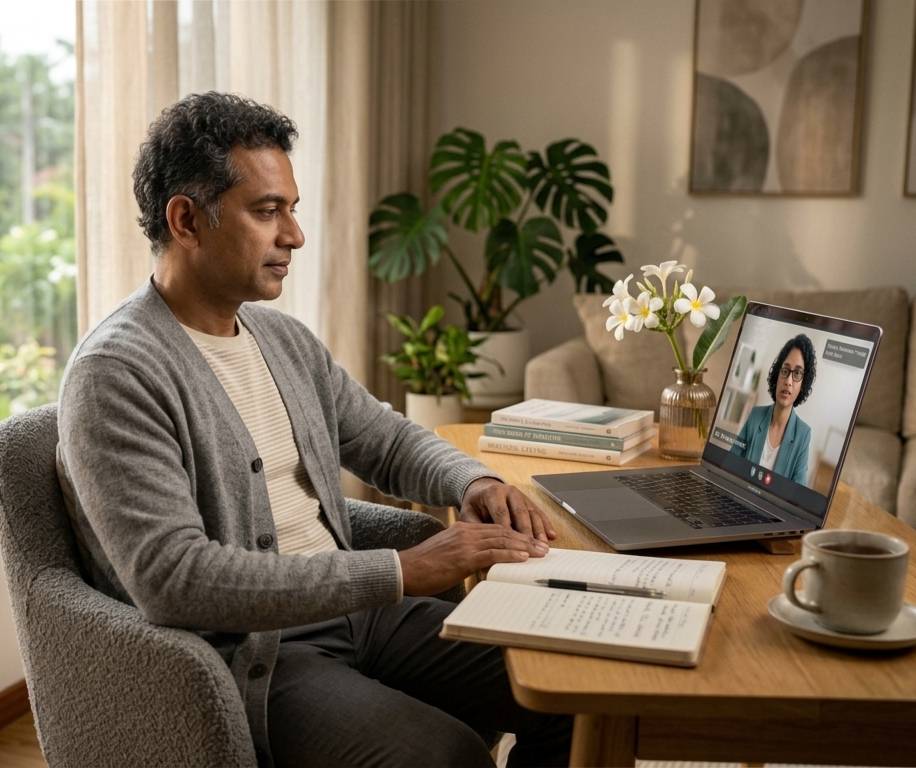
Online Therapy for Anxiety: Does It Really Work?
Anxiety disorders affect approximately 284 million people worldwide, making them the most prevalent mental health conditions globally. Despite being among the most treatable psychological conditions — with response rates of 60–80% for evidence-based treatment — the majority of people with anxiety disorders never receive adequate professional support. Online therapy has the potential to close this treatment gap significantly, but the quality and format of online provision varies enormously. This article examines what the research actually shows.
Does Online Therapy Work for Anxiety?
The short answer is yes — with an important qualification. Therapist-guided internet-based CBT (iCBT) for anxiety disorders has been shown in multiple large-scale meta-analyses to produce outcomes equivalent to in-person CBT. The qualification is that format matters: therapist-guided programmes significantly outperform self-guided apps and digital tools without human therapist involvement.
The most comprehensive evidence comes from a 2018 meta-analysis in World Psychiatry (Carlbring et al.) pooling 65 RCTs, which found no statistically significant difference in outcomes between internet-based and face-to-face CBT for anxiety disorders (SMD = 0.04, 95% CI: −0.29 to 0.37). A 2021 network meta-analysis in JAMA Psychiatry confirmed that guided iCBT is the most evidence-supported digital format, with significantly larger effect sizes than unguided digital interventions.
Which Anxiety Disorders Respond Best to Online Therapy?
The evidence base is strongest for the most prevalent anxiety presentations:
Generalised Anxiety Disorder (GAD)
GAD — characterised by persistent, excessive worry across multiple life domains — has one of the most robust evidence bases for online CBT. Multiple trials have demonstrated large effect sizes for online CBT in GAD, with effects maintained at 12-month follow-up. The CBT model addresses the cognitive patterns (intolerance of uncertainty, overestimation of threat probability) and behavioural patterns (reassurance-seeking, excessive planning) that maintain chronic worry.
Panic Disorder
Online CBT for panic disorder has been studied extensively and shows equivalence to in-person delivery. The structured CBT format — incorporating psychoeducation, cognitive restructuring, and interoceptive exposure — is particularly well suited to online delivery because the exposure components can be self-practised between sessions with therapist guidance.
Social Anxiety Disorder
Social anxiety disorder — marked by intense fear of social scrutiny, judgement, or embarrassment — shows a potentially interesting advantage with online delivery: the reduced social exposure of the therapeutic context itself may lower the initial barrier to engagement for people whose avoidance extends to seeking help in person. Multiple trials show large effect sizes for online CBT in social anxiety.
Health Anxiety
Health anxiety (formerly hypochondria) responds well to online CBT targeting the reassurance-seeking and hypervigilance cycles that maintain excessive medical worry. Online platforms provide convenient access without the paradox of attending a medical setting, which can reinforce health anxiety patterns.
What a Good Online Anxiety Programme Should Include
Not all online therapy platforms are equivalent. Based on the clinical trial literature, an evidence-based online anxiety programme should include:
- Licensed therapist with anxiety specialism: The therapist component is the active ingredient. Platforms that match you with a therapist specialising in anxiety — rather than a generalist — produce the most consistent outcomes
- Structured CBT content: Psychoeducation about the anxiety model, thought records, cognitive restructuring, and behavioural exposure components
- Between-session contact: Daily or regular therapist feedback on worksheet activities maintains therapeutic momentum and allows real-time course correction
- Exposure protocol: Any evidence-based anxiety programme should include a graded exposure component — the absence of this is a significant red flag in an anxiety-focused programme
- Validated outcome tracking: Regular mood and symptom assessment using validated tools (GAD-7, PHQ-9) allows both client and therapist to track progress objectively
Online-Therapy.com meets all of these criteria — it offers a specialist anxiety and stress CBT programme with licensed therapist matching, structured daily worksheets with feedback, and live session options, built around the clinical CBT protocols used in the trials demonstrating equivalence to in-person therapy.
Self-Help vs Therapist-Guided: What the Research Says
A key finding from the meta-analytic literature is the significant difference between guided and unguided online interventions. A 2019 Cochrane review found that unguided self-help interventions for anxiety produced effect sizes of approximately d = 0.50 — moderate and clinically meaningful, but significantly smaller than the large effects (d = 0.80–1.10) consistently seen with therapist-guided formats. For mild anxiety, self-guided digital tools and self-help CBT workbooks may be sufficient. For moderate-to-severe anxiety, or anxiety that has not improved with self-help, therapist-guided online CBT is the evidence-supported step up.
Medication vs Online Therapy for Anxiety
NICE guidelines recommend CBT (alone or in combination with medication) as first-line treatment for most anxiety disorders, based on the evidence that psychological treatment produces more durable effects than medication alone. SSRIs and SNRIs produce equivalent short-term effects to CBT for most anxiety disorders but are associated with higher relapse rates upon discontinuation. Combined treatment (CBT plus medication) outperforms either alone for moderate-to-severe presentations. For people who have not responded to medication alone, adding CBT consistently produces additional clinical benefit.
How Long Does Online Therapy for Anxiety Take?
A full course of CBT for an anxiety disorder typically runs 8–16 sessions over 2–4 months. Research shows that meaningful symptom improvement is typically detectable from session 4 onwards, with the largest gains occurring in the first 8 sessions. Continued practice of CBT skills after treatment ends is associated with sustained gains and reduced relapse — the skills learned in therapy have a durable protective effect beyond the treatment period itself.
References & Further Reading
- Carlbring P, et al. (2018). Internet-based vs. face-to-face cognitive behaviour therapy. World Psychiatry, 17(1), 29–38.
- Karyotaki E, et al. (2021). Guided or self-guided internet-based CBT for mental health problems. JAMA Psychiatry, 78(7), 810–819.
- Rith-Najarian LR, et al. (2019). A meta-analysis of technology-assisted self-help interventions for anxiety and depression. Clinical Psychology Review, 67, 91–111.
- National Institute for Health and Care Excellence. (2019). Generalised anxiety disorder and panic disorder in adults: management. Clinical Guideline CG113.
- Hofmann SG, et al. (2012). The efficacy of cognitive behavioral therapy: A review of meta-analyses. Cognitive Therapy and Research, 36(5), 427–440.
- Bandelow B, et al. (2015). Efficacy of treatments for anxiety disorders: a meta-analysis. International Clinical Psychopharmacology, 30(4), 183–192.