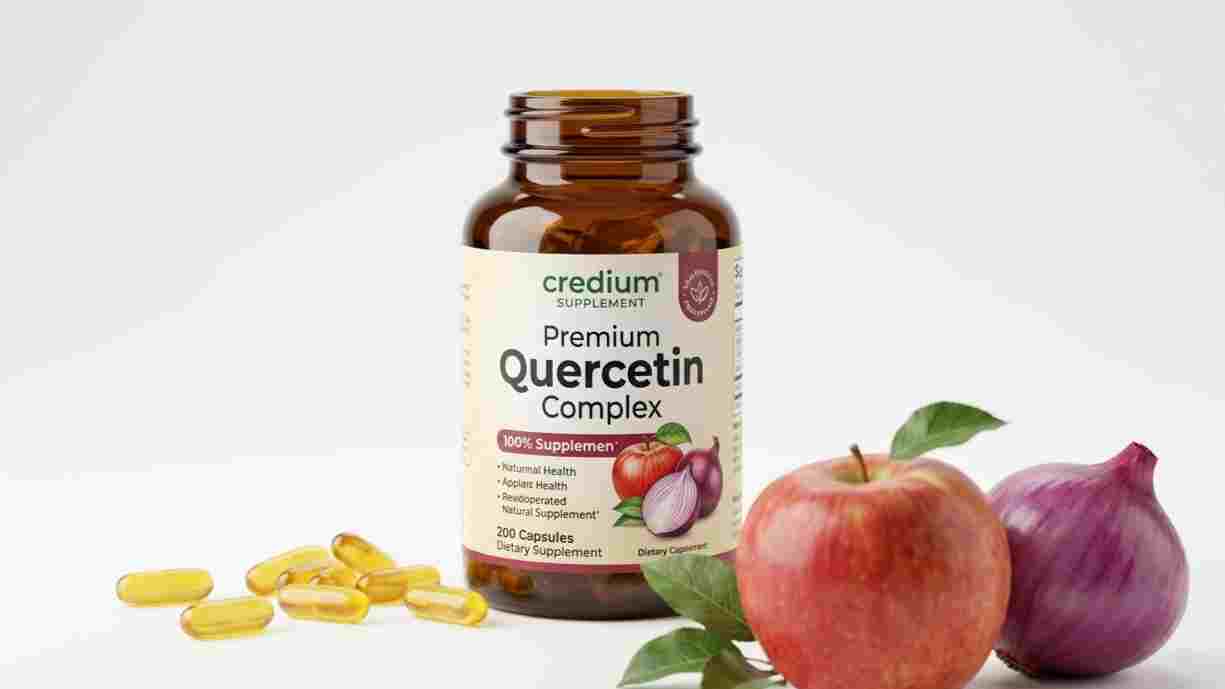
Best Quercetin Supplement: Why Quercetin Phytosome Outperforms Standard Quercetin by 20x
Quercetin is one of the most promising dietary flavonoids — but standard quercetin powder supplements dramatically underdeliver on the evidence. The positive clinical trials that demonstrated accelerated viral clearance, reduced infection severity, and anti-inflammatory benefits used enhanced bioavailability formulations — not the standard powder found in most mass-market quercetin capsules. Understanding the difference determines whether you are buying real immune and anti-aging support or an expensive flavouring agent.
The Bioavailability Problem
Quercetin aglycone (the standard form in most supplements) has several absorption obstacles: it has low aqueous solubility, is metabolised extensively in the intestinal wall by sulfotransferases and glucuronosyltransferases, and the resulting metabolites have lower biological activity than the parent compound. Studies on standard quercetin powder typically show only 1–2% oral bioavailability — the vast majority is metabolised or excreted before reaching systemic circulation.
Formulation Types — Ranked by Bioavailability
1. Quercetin Phytosome (Quercefit® / QUERCETIN PHYTOSOME®) — Best Overall
Quercetin Phytosome is quercetin complexed with sunflower phospholipids (phosphatidylcholine) in a 1:2 ratio. The phospholipid coating protects quercetin from premature metabolism and dramatically improves both solubility and membrane transport. Clinical pharmacokinetic data shows Quercetin Phytosome achieves approximately 20-fold higher plasma concentrations than equivalent doses of standard quercetin — a transformative bioavailability advantage. This is the formulation used in the 100-patient COVID-19 RCT that found significantly faster viral clearance (p=0.0004). When a quercetin supplement claims clinical relevance, check whether it uses Quercetin Phytosome — if it doesn't, it is unlikely to replicate the trial results.
2. Isoquercetin (Quercetin-3-O-β-D-Glucopyranoside)
Isoquercetin is a naturally occurring quercetin glycoside found in onions and other quercetin-rich foods. It shows over 4-fold higher bioavailability than standard quercetin aglycone in pharmacokinetic studies — absorbed more efficiently through glucose transporters in the intestinal epithelium. Isoquercetin is water-soluble (unlike standard quercetin), which further aids absorption. It is a good choice when Quercetin Phytosome is unavailable, though still below Phytosome bioavailability.
3. Quercetin with Bromelain
Bromelain (pineapple enzyme) enhances quercetin absorption by reducing intestinal barrier resistance and may have complementary anti-inflammatory effects through different mechanisms (inhibition of prostaglandin synthesis and fibrin-driven inflammation). This combination is widely available and represents a meaningful improvement over standard quercetin alone — commonly sold for allergy and sinus inflammation support, where both compounds have relevant mechanisms.
4. Standard Quercetin Aglycone (Lowest Bioavailability)
Standard quercetin powder without any bioavailability enhancement is the most widely sold format and the least effective per stated milligram. Higher doses (1000–2000mg) can compensate partially — the 1002-patient URTI trial that found 36% severity reduction used 1000mg daily of standard quercetin — but cost-efficiency is poor compared to enhanced formulations.
Synergistic Combinations That Actually Matter
Quercetin + Vitamin C
Vitamin C regenerates oxidised quercetin back to its active form, extending its effective half-life in tissues. Simultaneously, quercetin chelates iron (reducing free radical generation from iron-mediated oxidative reactions) in a way that complements vitamin C's own antioxidant chemistry. The combination has been specifically studied for antiviral applications and provides genuinely synergistic (not merely additive) antiviral and antioxidant protection.
Quercetin + Zinc
This combination is based on quercetin's zinc ionophore activity — quercetin increases cellular zinc uptake, and intracellular zinc directly inhibits RNA-dependent RNA polymerase (RdRp), the enzyme viruses use to replicate their RNA. Without adequate intracellular zinc, the ionophore function has no substrate to work with. Clinical protocols for viral infection have combined quercetin (500mg) with zinc (25–50mg elemental zinc) for this synergistic antiviral rationale.
Quercetin + Resveratrol
Both activate SIRT1 and suppress NF-kB — with complementary mechanisms. Quercetin also inhibits the same enzymes that metabolise resveratrol (sulfotransferases, glucuronosyltransferases), substantially increasing resveratrol plasma levels when co-supplemented. This is a mechanistically sound longevity stack with supporting clinical evidence for both compounds independently.
Quercetin + Curcumin
The combination with the strongest cancer prevention evidence: a Phase II RCT in familial adenomatous polyposis patients found 60% adenoma reduction with quercetin 20mg + curcumin 480mg daily for 6 months. Both compounds inhibit NF-kB and induce Phase II detoxification enzymes, with complementary mechanisms on apoptosis and cell cycle regulation in pre-cancerous cells.
Label Reading Guide
- ✓ "Quercetin Phytosome" or "Quercefit®" — highest bioavailability, matches positive RCT formulation
- ✓ "Isoquercetin" (quercetin-3-glucoside) — good bioavailability alternative
- ✓ Source stated (onion skin extract, Japanese pagoda tree) — indicates quality sourcing
- ✓ Third-party purity testing — look for Informed Sport, NSF, USP
- ✗ "Quercetin" without form specified — almost certainly standard aglycone powder
- ✗ Doses below 250mg as primary quercetin source — unlikely clinically relevant without Phytosome formulation
- ✗ "Quercetin complex" without specifying what the complex is
Dosing Guide
- Quercetin Phytosome — prevention: 250–500mg daily with food
- Quercetin Phytosome — acute antiviral support: 500mg 2–3x daily for 1–2 weeks (matches COVID-19 RCT protocol)
- Standard quercetin — prevention: 500–1000mg daily (higher dose needed to compensate for lower bioavailability)
- Senolytic use: 500–1000mg quercetin phytosome for 2 consecutive days per week (intermittent senolytic dosing protocol)
- Safe ceiling: Up to 2000mg/day evaluated in clinical trials without serious adverse events
References
- Di Pierro F, et al. (2022). Quercetin Phytosome for early COVID-19. Front Pharmacol, 13:1096853.
- Agrawal PK, et al. (2020). Quercetin antiviral significance. Nat Prod Commun.
- Indena SpA. Quercefit pharmacokinetics: 20x plasma levels vs standard quercetin.
- Kwon KH, et al. (2009). Quercetin + curcumin in FAP: Phase II. Clin Gastroenterol Hepatol.