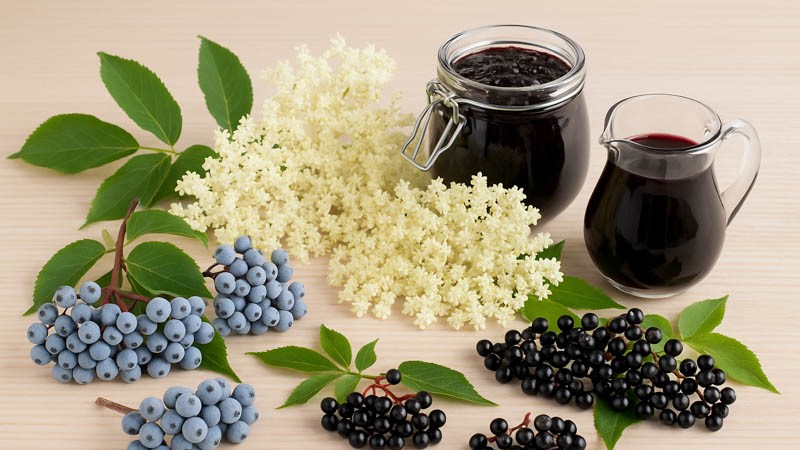
Elderberry for Colds and Flu: What the Randomised Trials Actually Show
Elderberry is one of the few herbal supplements with a genuinely credible clinical evidence base for cold and flu — and one of the fewer still where the mechanism is well-understood at the molecular level. But the evidence is not uniformly positive: a 2020 Cleveland Clinic RCT found no benefit at all for influenza, directly contradicting three earlier trials. Understanding why these results diverge is essential to knowing whether elderberry is worth taking and when.
What Elderberry Actually Does Biologically
Black elderberry (Sambucus nigra) contains exceptionally high concentrations of anthocyanins — especially cyanidin-3-glucoside and cyanidin-3-sambubioside. These compounds work through two distinct mechanisms against respiratory viruses:
Direct antiviral action: Elderberry anthocyanins bind to viral haemagglutinin — the spike-like surface protein that influenza viruses (and other respiratory viruses) use to attach to and enter host cells. By blocking this protein, elderberry physically prevents viral entry and reduces the rate of cellular infection. Laboratory studies confirm a therapeutic index of 12 ± 1.3 in the post-infection phase, with stronger effect after cells are already exposed than before — suggesting elderberry works better as a treatment than as prevention.
Immune modulation: Elderberry stimulates production of cytokines including IL-6, IL-8, and TNF-α — signalling molecules that activate immune cells and accelerate pathogen clearance. It also has anti-inflammatory properties that may prevent excessive immune activation. This dual role — immune stimulant early in infection, anti-inflammatory during recovery — is relevant to the cytokine storm concern raised during COVID-19 (addressed below).
The Positive Evidence
Meta-Analysis: Large Effect on Upper Respiratory Symptoms (2019)
The most comprehensive analysis of elderberry RCTs (Hawkins et al., 2019, Complementary Therapies in Medicine) pooled 180 participants across randomised controlled trials. The quantitative synthesis found a large mean effect size for elderberry supplementation in reducing upper respiratory symptoms. The authors concluded elderberry presents a potentially viable alternative to antibiotic misuse for viral respiratory infections — a significant conclusion given antibiotic resistance concerns.
Air Traveller RCT: 57 vs 117 Cold Episode Days (2016)
The largest and most methodologically rigorous elderberry trial enrolled 312 economy class passengers travelling from Australia on long-haul international flights — a setting where cold transmission risk is high and confounders are controllable (Tiralongo et al., Nutrients, 2016). Participants received either 600mg elderberry extract before travel and 900mg daily during the trip, or matched placebo.
Results were striking: the elderberry group recorded a total of 57 cold episode days versus 117 days in the placebo group — less than half. Duration of colds that did develop was 2 days shorter in the elderberry group (4.75 vs 6.88 days). Symptom severity was less than half that of placebo (score of 21 vs 34). This trial is widely cited as the strongest evidence for elderberry and cold prevention in high-risk settings.
Influenza Trials: 4 Days Faster Recovery (1995, 2004)
Two earlier double-blind, placebo-controlled trials in patients with confirmed influenza both found that elderberry syrup shortened illness by approximately 4 days compared to placebo — statistically significant in both cases. In the 2004 trial (Zakay-Rones et al., Journal of International Medical Research), 60 flu patients using elderberry syrup for 5 days recovered an average of 4 days faster with significantly reduced rescue medication use. The 1995 trial in 27 patients during an influenza B outbreak found complete symptom resolution in 90% of the elderberry group within 2–3 days versus 6 days for placebo.
The Contradictory Evidence
Cleveland Clinic RCT: No Benefit (2020)
A 2020 FDA-approved, investigator-initiated double-blind RCT at three Cleveland Clinic emergency departments (Macknin et al., Journal of General Internal Medicine) enrolled 87 patients with PCR-confirmed influenza. Participants received elderberry extract or placebo for 5 days. The result: no difference in days to symptom resolution (4.9 days placebo vs 5.3 days elderberry; p=0.57). The authors concluded they found no evidence of elderberry benefit and noted a post-hoc trend toward worse outcomes in the elderberry-only group (without oseltamivir).
This trial is methodologically strong — FDA-approved, PCR-confirmed diagnosis, multiple sites — and cannot be dismissed. Possible explanations for the discrepancy with earlier trials include: (1) the late timing of intervention (patients had symptoms for up to 48 hours before enrolment in a busy ER setting, versus earlier treatment in positive trials); (2) the patient population (ER patients with potentially more severe disease); (3) differences in elderberry preparation and anthocyanin standardisation; (4) the high rate of concurrent oseltamivir use confounding the analysis.
The Cytokine Storm Question
During the COVID-19 pandemic, concern emerged that elderberry's immune-stimulating cytokine effects might worsen cytokine storm in severe viral illness. The available evidence does not support this concern in otherwise healthy individuals taking elderberry at standard doses. The systematic review by Wieland et al. (2021) specifically examined this question and found no clinical evidence of harmful immune overactivation. The immunomodulatory effects of elderberry appear to be context-dependent — stimulating immune response early in mild illness, with some anti-inflammatory activity that limits excess activation.
When Elderberry Is Worth Taking
Based on the totality of evidence, elderberry appears most beneficial in specific contexts:
- High-risk exposure settings: Travel, schools, crowded events — the air traveller trial is the most directly applicable evidence for this scenario
- Early treatment at first symptoms: The antiviral mechanism (blocking viral entry) is most relevant early in infection when viral load is still building. Studies that enrolled patients within 24–48 hours of symptom onset showed the strongest results
- Common cold rather than severe influenza: The evidence for common cold reduction is more consistent than for confirmed influenza
- As an alternative to antibiotics: For viral upper respiratory infections where antibiotics are inappropriate, elderberry provides a pharmacologically rational and clinically supported option
Dosing Protocol
- Prevention during high-risk periods: 300–600mg standardised extract daily
- Acute treatment (at first symptoms): 600–900mg daily for 5–7 days — begin within 24–48 hours of symptom onset for maximum benefit
- Syrup format: 15ml (1 tablespoon) of standardised elderberry syrup, 4 times daily for acute illness (equivalent to most trial protocols)
References
- Hawkins J, et al. (2019). Black elderberry supplementation effectively treats upper respiratory symptoms: meta-analysis. Complement Ther Med, 42:361–5.
- Tiralongo E, Wee SS, Lea RA. (2016). Elderberry supplementation reduces cold duration in air-travellers: RCT. Nutrients, 8(4):182.
- Zakay-Rones Z, et al. (2004). Randomized study of elderberry extract in influenza A and B treatment. J Int Med Res, 32(2):132–40.
- Macknin M, et al. (2020). Elderberry extract outpatient influenza treatment: RCT. J Gen Intern Med, 35(11):3271–7.
- Wieland LS, et al. (2021). Elderberry for viral respiratory illness: systematic review. BMC Complement Med Ther, 21(1):112.