Cruciferous Vegetables and Cancer Prevention: The Sulforaphane, Nrf2, and Glucosinolate Science
Broccoli, Brussels sprouts, cauliflower, kale, watercress, and cabbage belong to the Brassica family of vegetables — and they contain a class of compounds called glucosinolates that, when metabolised, produce some of the most potent food-derived cancer-preventive molecules yet identified. Chief among these is sulforaphane (SFN) — a compound whose mechanism is so precisely characterised and whose clinical trial record is now so substantial that it has crossed from interesting dietary compound to serious pharmaceutical candidate.
Understanding how cruciferous vegetables work — and why preparation method matters enormously — starts with the chemistry.
The Glucosinolate-Myrosinase System
Glucoraphanin is the inactive precursor glucosinolate stored in broccoli cells. Myrosinase is a plant enzyme stored separately in adjacent cells. When you chew broccoli — or chop it — the cell walls break, glucoraphanin and myrosinase mix, and the enzymatic reaction produces sulforaphane. This system appears to be an evolved plant defence mechanism against insects and pathogens. In humans, it becomes a highly effective cancer-preventive pathway.
The critical practical implication: heat destroys myrosinase. Heavily cooked or overboiled broccoli retains the glucoraphanin but cannot convert it to sulforaphane — the active compound. Studies show that broccoli microwaved or boiled for more than 5 minutes loses most of its sulforaphane-forming capacity. The optimal preparation is light steaming (3–4 minutes maximum) or raw consumption. Gut bacteria can partially compensate for destroyed myrosinase by converting some glucoraphanin to sulforaphane directly, but this is significantly less efficient.
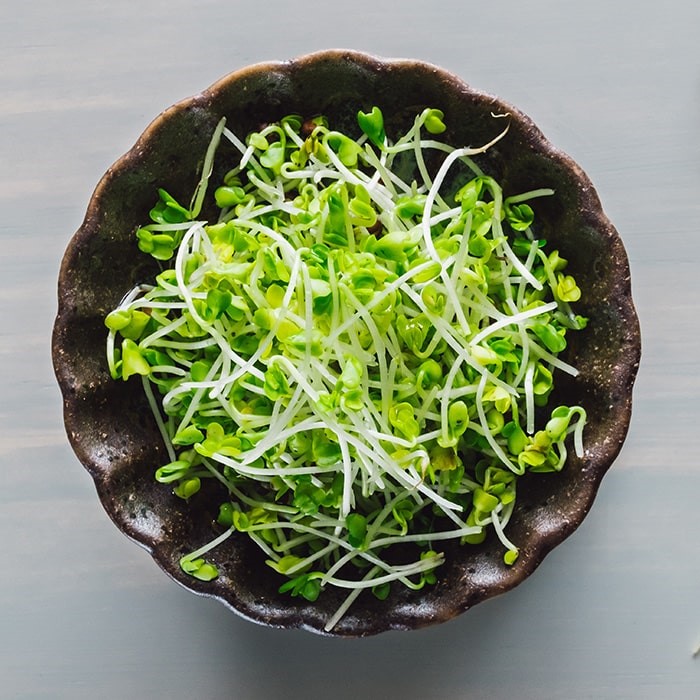
Broccoli sprouts contain 20–100 times more glucoraphanin per gram than mature broccoli — making them the most concentrated dietary sulforaphane source available. A single tablespoon of broccoli sprouts provides an amount of glucoraphanin equivalent to approximately 100g of mature broccoli.
The Keap1-Nrf2 Mechanism: How Sulforaphane Prevents Cancer
Sulforaphane's primary anti-cancer mechanism operates through the Keap1-Nrf2-ARE (antioxidant response element) pathway — one of the most important cellular defence systems in human biology.
Under normal conditions, the transcription factor Nrf2 is sequestered in the cytoplasm by the protein Keap1, which marks it for degradation. When sulforaphane enters the cell, it chemically modifies specific cysteine residues on Keap1, disrupting its grip on Nrf2. Freed Nrf2 translocates to the cell nucleus, binds to antioxidant response elements in the DNA, and drives the transcription of a battery of Phase II detoxification enzymes:
- NQO1 (NAD(P)H quinone dehydrogenase): Neutralises quinone-based carcinogens
- Glutathione S-transferases (GSTs): Conjugate electrophilic carcinogens with glutathione for safe elimination
- Heme oxygenase-1 (HO-1): Anti-inflammatory, cytoprotective
- Gamma-glutamylcysteine synthetase (γ-GCS): Rate-limiting enzyme in glutathione synthesis — elevates cellular glutathione levels
- Thioredoxin reductase: Maintains intracellular redox balance
This enzyme cascade neutralises carcinogens at the point of entry — before they can cause DNA strand breaks that initiate cancer. The protection is broad-spectrum: these enzymes neutralise carcinogens from tobacco smoke, charred food, industrial pollution, and endogenous metabolic processes.
Sulforaphane also inhibits NF-kB (suppressing cancer-promoting inflammation), inhibits histone deacetylases (restoring tumour suppressor gene expression silenced by epigenetic changes), and directly induces apoptosis in cancer cell lines — particularly through Bax/Bcl-2 pathway modulation and caspase-3 activation.
The Epigenetic Cancer Prevention Mechanism
One of the most significant recent discoveries about sulforaphane is its epigenetic activity. Cancer development frequently involves epigenetic silencing of tumour suppressor genes — DNA methylation or histone deacetylation events that switch off genes that would otherwise stop abnormal cell growth. Sulforaphane is a potent inhibitor of histone deacetylases (HDACs), and in prostate cancer cells specifically, it also inhibits DNA methyltransferases (DNMTs) — resulting in demethylation of tumour suppressor gene promoters and restoration of their expression.
Critically, this was shown to occur in humans: a clinical study found that healthy volunteers who consumed broccoli sprouts showed decreased HDAC activity in peripheral blood mononuclear cells within hours of consumption — demonstrating that the epigenetic effects of sulforaphane are pharmacologically active at dietary doses in humans, not just in cell culture.
The Clinical Trial Evidence: 84 Trials, 39 Published
A 2025 comprehensive analysis (published in the Journal of Nutritional Science) identified 84 clinical trials registered on ClinicalTrials.gov examining sulforaphane or broccoli-derived extracts. Of these, 39 have been published. Key findings across the cancer-relevant trials:
- Prostate cancer: In GSTM1-positive individuals (those with a functional carcinogen detoxification gene), broccoli-rich diets produced significant transcriptional changes in prostate tissue in the ESCAPE trial (12-month RCT). A Phase II trial in men with recurrent prostate cancer found that 200 micromoles/day of sulforaphane-rich extracts modulated PSA doubling time — a marker of disease progression
- Breast cancer: Early-stage (ductal carcinoma in situ) studies showed decreased HDAC activity and reduced cell proliferation markers (Ki-67) in breast tissue after sulforaphane intervention. Effects were less consistent in advanced disease — consistent with sulforaphane being a prevention rather than treatment compound
- Oral cancer prevention: A Phase II trial demonstrated that sulforaphane reduced carcinogen-induced lesion formation in a high-risk oral cancer model
- General carcinogen detoxification: Multiple RCTs in healthy subjects confirmed significant induction of Nrf2-regulated detoxification markers (NQO1, HO-1) in blood and buccal cells after broccoli sprout consumption
The Epidemiological Evidence
Large prospective cohort studies consistently associate high cruciferous vegetable intake with significantly reduced cancer risk across multiple cancer types:
- Colorectal cancer: Meta-analyses of cohort studies find approximately 20% lower colorectal cancer risk in highest versus lowest cruciferous vegetable intake quintiles
- Bladder cancer: One of the strongest associations — high cruciferous vegetable intake associated with approximately 25–30% lower bladder cancer risk in several large cohort studies; the bladder exposure to urinary sulforaphane metabolites may explain this specificity
- Lung cancer: Particularly in smokers, high cruciferous vegetable intake is associated with meaningful lung cancer risk reduction — consistent with the carcinogen-neutralisation mechanism operating on tobacco smoke carcinogens in respiratory tissue
Practical Protocol: Maximising Sulforaphane From Cruciferous Vegetables
- Choose broccoli, Brussels sprouts, or watercress for highest glucoraphanin content
- Chop or chew thoroughly before cooking — allow 5–10 minutes after chopping for myrosinase conversion before applying heat
- Steam for 3–4 minutes maximum — light steaming preserves most myrosinase activity; boiling or microwaving destroys it
- Add broccoli sprouts to salads or smoothies (raw) — the most concentrated sulforaphane source per gram
- Add mustard seed powder to cooked broccoli — mustard contains myrosinase that can partially restore sulforaphane production in cooked vegetables
- Daily target: 1–2 servings of cruciferous vegetables; the ESCAPE trial used daily broccoli consumption over 12 months to produce prostate tissue changes
References
- Bahadori M, et al. (2025). Sulforaphane clinical trials — comprehensive analysis of 84 trials. J Nutr Sci.
- Traka MH, et al. (2019). ESCAPE trial: 12-month broccoli intervention, prostate transcriptomic changes. Am J Clin Nutr, 109:1133–44.
- Myzak MC, et al. (2006). Sulforaphane inhibits HDAC activity in prostate epithelial cells. Carcinogenesis, 27:811–819.
- Alumkal JJ, et al. (2015). Phase II sulforaphane in recurrent prostate cancer. Invest New Drugs, 33(2):413–23.